



Celebrating our City’s phenomenal heritage and its people
30 August 2024
Our historic City and its setting are the quality for which Durham is universally known and loved around the World and is the key stewardship issue for our residents and the many millions of visitors we welcome each year. The City of Durham Parish Council works tirelessly to promote, educate and shine a spotlight on our rich and diverse heritage as a City and in our role as a medieval city in the North East region. Find out more about the work we have done to promote this heritage since we began in 2018.
The importance of our heritage aspect has been recognised by the designation of the Cathedral and Castle as a World Heritage Site and the designation of the Durham City Conservation Area and the Burn Hall Conservation Area.
City of Durham Parish Council blue plaques scheme
The City of Durham Parish Council has produced a number of blue plaques around the parish area, as part of our efforts to highlight hidden gems and historical locations. These blue plaques seek to celebrate a person, event or building of significance and have been popular with visitors and local residents.
We were delighted to receive so many nominations for plaques as part of our public nomination process in 2022.
Most recently, we were delighted to welcome Sir Brendan Foster as well as Olympic Gold medal winners Jayne Torvill and Christopher Dean to unveil these blue plaques for us.
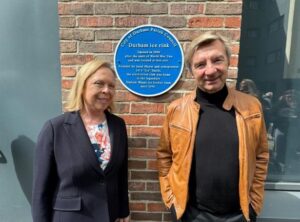
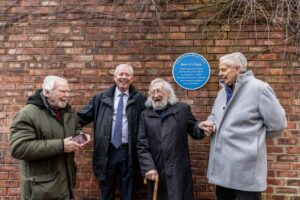
Later this year, we intend on unveiling two further such plaques: a plaque dedicated to the renowned archaeologist and first female professor of Durham University Professor Rosemary Cramp as well as a blue plaque dedicated to 33 Claypath – a first women’s hostel of its kind allowing women to access higher education. Please look out for more news on these exciting projects.
Our plaques this year have centred around the themes of celebrating the very great, rich and diverse women’s history we are blessed to have in our City.
Our existing plaques include:
• Daisy Edis – 142 Gilesgate Daisy Edis (1888 – 1964) Pioneering Durham professional photographer lived at 142 Gilesgate and worked from her studio at 52 Sadler Street.

• Mary Gibson, Dora Heslop and Winifred Hindmarch – Chapel, St. Hild and St. Bede’s College. Here in 1898 Mary Gibson, Dora Heslop and Winifred Hindmarch graduated from St Hild’s Training College becoming the first female graduates of Durham University. Supra montem posita. [Placed above the mountain]

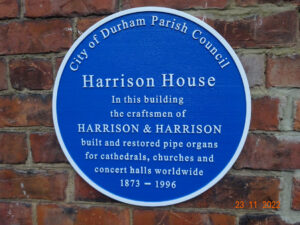
• Harrison House, Hawthorn Terrace. In this building the craftsmen of Harrison & Harrison built and restored pipe organs for cathedrals, churches and concert halls worldwide 1873 – 1996
• The Market Hall – outside the Market Hall. Market Hall. Designed by Philip Charles Hardwick for Durham Markets, a company created by Act of Parliament in 1851, on the site of New Place, the Tudor town house of the Earls of Westmorland. Built in two phases and opened in December 1852. Extensively refurbished in 1996 to facilitate 6 days a week trading.

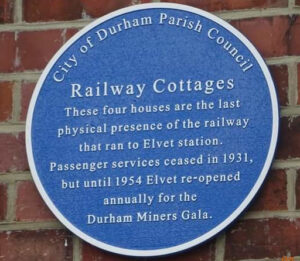
• The Railway Cottages – Green Lane. Railway Cottages. These four houses are the last physical presence of the railway that ran to Elvet station. Passenger services ceased in 1931 but until 1954 Elvet re-opened annually for the Durham Miners Gala.
• Neville House – Ustinov College. Neville House. Original site of Neville’s Cross College opened September 1921 as a teacher training college. Now home to Ustinov College, Durham University, opened September 2017 to continue the tradition of academic development and support for postgraduate students.

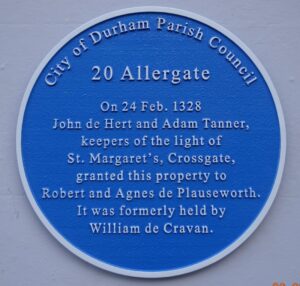
• 20 Allergate. 20 Allergate. On 24 Feb 1328 John de Hert and Adam Tanner, keepers of the light of St Margaret’s, Crossgate, granted this property to Robert and Agnes de Plauseworth. It was formerly held by William de Cravan
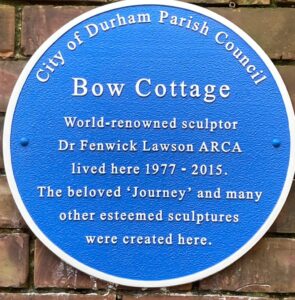
• Fenwick Lawson – Bow Cottage, Bow Lane Bow Cottage. World-renowned sculptor Dr Fenwick Lawson ARCA lived here 1977 – 2015. The beloved ‘Journey’ and many other esteemed sculptures were created here.
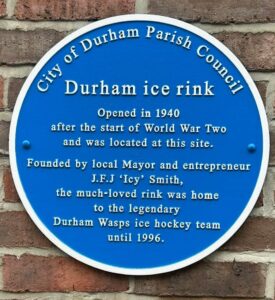
• Durham City Ice Rink. Durham ice rink opened in 1940 at the start of World War Two and was located at this site. Founded by local entrepreneur John ‘Icy’ Smith, the much-loved rink was home to the legendary Durham Wasps hockey team until 1996.
Preserving the scheduled monument of Neville’s Cross
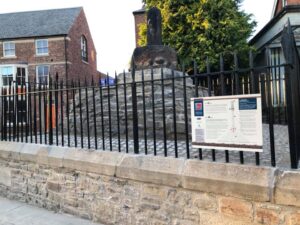
Sunday October 17th 2021 marked the 675th Anniversary of the Battle of Neville’s Cross. As part of a substantial project in our area, the Parish Council funded the professional restoration works on the Neville’s Cross monument in our parish.
The Battle of Neville’s Cross took place during the Second War of Scottish Independence on 17 October 1346. An invading Scottish army of 12,000 led by King David II was defeated with heavy losses by an English army of approximately 6,000–7,000 men led by Lord Ralph Neville.
In addition, the Neville’s Cross Battle Walk was inaugurated in October 1996 as part of the 650th anniversary commemoration of the battle. The newly-waymarked route followed existing paths and roads and an accompanying leaflet has now been professionally re-produced by the Parish Council. The information boards along the route have also been refreshed.
Protecting and enhancing our precious heritage through the planning process
The City of Durham Parish Council acts as a statutory consultee on all planning matters within our parish area. As part of this work, our Planning and Licensing Committee considers between 300-400 development applications each year; many of which are located within our precious Conservation Area or World Heritage Site.
Through this work, we have ensured that inappropriate development, detrimental to the setting of either our designated or non-designated heritage assets, has been refused and that development opportunities to promote and enhance the significance of our area and its heritage assets are approved and promoted.
In addition, the Parish Council saw through the adoption of the Durham City Neighbourhood Plan – our plan, by local residents, created by a hard-working team of dedicated volunteers and which will guide development in our area for several years to come. Within this document, we have ensured that planning policy is such that our heritage assets are preserved into the future – Durham City Neighbourhood Plan Policies H1, H2 and S1 being just a few examples of this.
Moreover, we have represented our community at consultations, public inquiries and the Examination in Public for the County Durham Plan, in order to ensure that we get the right development for our area.
Producing a Conservation Area Management Plan
Most recently, the Parish Council is helping to produce a Conservation Area Management Plan and, alongside local volunteers, is carrying out an assessment of each of the 313+ non-designated heritage assets located within our parish area.
The key objective of this work is to define the special interest of Durham City Conservation Area. It identifies and evaluates the contribution of the different elements and features contributing to its distinctiveness, sense of place, character and appearance that justifies its designation.
It then identifies the issues, problems, potential threats the conservation area faces, and the opportunities, that helps to inform the overarching realistic and deliverable management aims set out in the management strategy.
The appraisal will provide an important tool and evidence base to inform the areas on-going management to ensure its special architectural and historic interest is conserved and where possible enhanced moving forwards.
It has been prepared in accordance with Historic England’s Advice Note 1, Conservation Area, Appraisal, Designation and Management, 2nd ed. (2019) The appraisals form part 2 of the Durham City Conservation Area Management Plan (CAMP) process. Part 1 is the Durham City Strategic Context document, and part 3 the Management Strategy.
Restoration of the Ruth First mural on Providence Row.
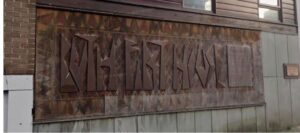
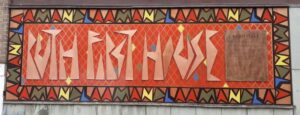
We were delighted to fund the restoration of a Durham City mural dedicated to the famous anti-apartheid campaigner and Durham University lecturer Ruth First.
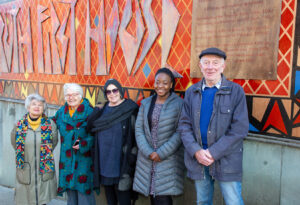
The City of Durham Parish Council commissioned the restoration of the mural by one of the original artists Lotte Shankland and were delighted to unveil this at a joint event with Durham University on Monday 7th March 2022.
The mural is located on the side of Ruth First House on Providence Row in the City. Ruth First was an exiled South African anti-apartheid activist, journalist and Sociology lecturer who lived in Durham between 1973 and 1978 and attended meetings in this building. Ruth was assassinated in Mozambique in 1982, where she was working while on leave from Durham University, by a parcel bomb sent by South African police.
The original plaque and artwork were erected to coincide with the first free democratic elections in South Africa in 1994. The mural was unveiled at the event by Ruth First’s former University colleague Hilary Wainwright and the current Ruth First Scholar Shamiso Zamba.
Parish Councillor Alan Doig said: “We are absolutely delighted to honour a wonderful person associated with our parish in this way. The original mural was looking very worn and the Parish Council is thrilled to have the restoration work commissioned by one of the original artists. This is such a great enhancement for Providence Row and a fitting dedication to a remarkable lady”.
“This year (2022) marks the 40th anniversary of Ruth’s tragic assassination. We really hope this mural continues to keep the memory of Ruth and the tolerance and justice she fought for alive. It is also exceptionally fitting that the mural was unveiled in the same week as International Women’s Day.”
Michael Thompson, Chair of the Ruth First Educational Trust, said: “Ruth First’s teaching, research, writing and political activism have inspired many people in Africa and the UK. The University is proud to honour that legacy by supporting the Ruth First Scholarship in partnership with the Ruth First Educational Trust and Durham City and County. The mural is a vivid memorial to a remarkable woman and a creative symbol of Durham’s commitment to the values that she fought for.”
Funding the excavation of the ancient Flass Well as part of the 50th Anniversary of the Flass Vale protest picnic which saved Flass Vale – the green lung of our City – from development.

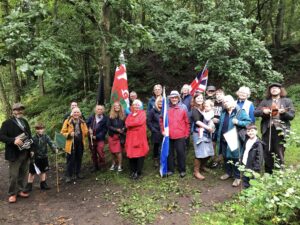
The Friends of Flass Vale recently organised a 50th Anniversary event for the Flass Vale Protest Picnic; a resident-led movement which helped to safeguard the Flass Vale from development and retain this precious resource as an important green lung in the heart of our City. The Friends of Flass Vale work tirelessly to keep this area beautiful and it is right that we mark our appreciation for the work they do.

In conjunction with this event, the Parish Council and local Ward Member Councillor Liz Brown have been working to carry out some environmental improvements to the area; including restoring the path leading to the Flass Well. Part of this work also included the excavation of the Flass Well (owned by Redhills) which was financed by the Parish Council and carried out by our terrific Durham University’s Archaeology department in August 2023. The 50th Anniversary event included an official opening of this ancient Well.
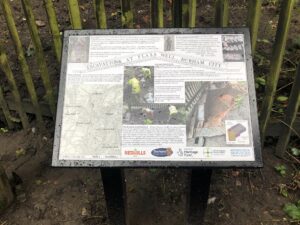
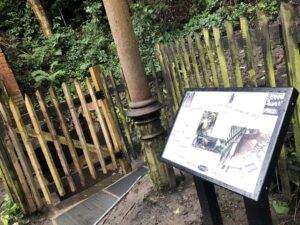
In addition, the University helped us to produce an interpretation board to show the history of the Well and its historical importance to residents, visitors, etc.
Very little is known about the Well itself however historically, pure and reliable water was very difficult to come by. The rare places where safe and fresh water sprang miraculously from the ground were known for miles around and were treated with the greatest reverence from pagan times.
As the North-East became Christianised, so the springs became regarded as holy wells. Many of them were dedicated to saints whose miraculous intervention was believed to have caused this life-giving water to gush endlessly out of the ground.
In County Durham, there are believed to be at least 30 holy wells which once had religious significance. Durham City has a number of these holy wells. Possibly the best preserved is the Flass Well, which can be accessed by the steps at the top of Mowbray Street and Flass Street. It is believed to have been used by local people during the winters of 1947-48 and 1962-63, when it provided pure spring water, but it is now so overgrown and full of rubbish that you cannot see it.
The Flass Well is beneath Redhills, the Durham Miners’ Association’s Hall, and as the association restores its site, the historic well is seen as a key part of this development.
Creating a number of spectacular walking routes for our residents and visitors to enjoy our culture and heritage.

The City of Durham Parish Council, alongside its partners in the City of Durham Trust, have recently produced 3 spectacular walking routes in our area as part of our work to promote our rich heritage to residents and visitors alike.
These walking routes include:
The Battle of Neville’s Cross trail
The Durham City Heritage trail
Already, these walks have been enjoyed by over 17,000 visitors and we were particularly overjoyed to launch the Heritage Trail walk to coincide with the 80th Anniversary of the City of Durham Trust – our great friends and partners in our efforts to promote and enhance our heritage.
Our sincere thanks to our friend David Miller for his exceptional work in helping us produce these trails.
Copies of each of these walking trails are available in locations across the City such as: Durham Town Hall, the Gala Theatre, Clayport library, Palace Green library, Merryoaks Community Hall and St Mary-le-Bow – Durham Heritage Centre
We are delighted to join with local authority colleagues in endorsing the key priorities for the Case for Culture:
CLIMATE: Pledging that the cultural sector will raise awareness of climate change and work together to reduce their carbon footprint.
HEALTH: Contributing to health and well-being.
FREELANCERS: Making the case for better pay and conditions for the independents, cultural SME’s and artists who underpin our cultural organisations.
DIVERSITY: Committing to reaching more people across the region and ensuring the arts and heritage sector is open and welcoming and engaged with all our communities.
INTERNATIONAL: Ensuring we are working with international partners, encouraging tourism and promoting the North East cultural offer to the world.
FUNDING: Making the case for significantly more culture funding and regional decision making.
City of Durham Parish Council responds to the new County Durham Plan scoping consultation
10 August 2026
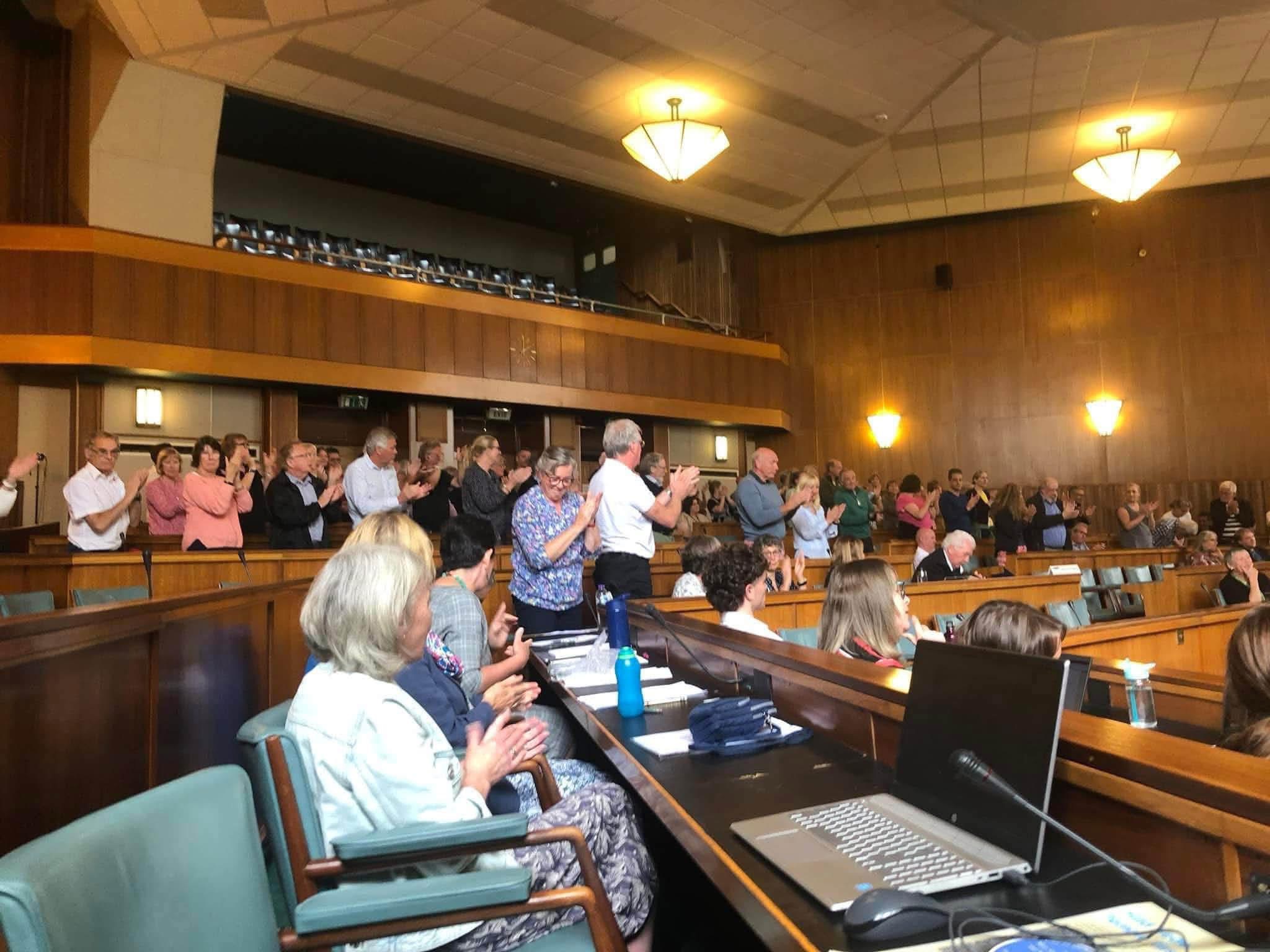
The City of Durham Parish Council has officially responded to an important consultation relating to the new County Durham Plan. A full copy of the City of Durham Parish Council’s...
Read More
Have your say on the City of Durham Parish Council’s priorities
08 August 2026
The City of Durham Parish Council is inviting residents to have their say on our priorities and the work we should focus on over the coming year. We want to...
Read More
